
- By Admin
-
 Construct Ion
-
 0 Comments
- News
- 342
Home Lift Comparison Guide: Installation Scope and After-Sales Terms to Compare Before Buying
Compare home lift offers by installation scope, after-sales terms, purchasing terms and acceptance criteria before buying. Platform, glass and shaft-built cabin lifts compared.
Home Lift Comparison Guide: Installation Scope and After-Sales Terms to Compare Before Buying
Two home lift offers can carry the same load figure and the same travel height and still commit the supplier to completely different work. One quote includes shaft framing, pit preparation, commissioning and a defined warranty route; the other assumes your builder delivers a finished shaft and that service will be arranged "locally" after handover. At the evaluation stage, that difference is the most expensive thing in the file, and it is usually invisible on the specification sheet.
This guide is written for the buyer comparing platform lifts, glass lifts and shaft-built cabin lifts before signing. It separates installation scope from after-sales terms, sets out the acceptance criteria to agree in writing, and uses three delivered projects — a Russian FT/FJ villa installation, an Australian shallow-pit shopping mall retrofit and an Indonesian hotel glass lift — to show what is verifiable and what a supplier should be asked to prove.
What "Installation Scope" Actually Means in a Home Lift Quote
Installation scope is the written boundary line between what the lift supplier delivers and what the buyer's site must provide. When that boundary is not written down, the same installation can be quoted twice: once by the lift supplier as "excluded civil work", and once by the local contractor at an unpredictable price.
A complete home lift installation scope normally has to answer six questions:
- Site survey and measurement: who confirms the shaft or opening dimensions, floor heights and headroom before production is released.
- Shaft and structural interface: whether the lift arrives with its own structure — an aluminium frame with glass shaft, or a bent steel structure — or whether a concrete, wood or brick shaft must already exist.
- Pit, floor opening and threshold work: pit depth, floor cutting and whether a flat threshold is part of the delivery.
- Power and control routing: who provides the supply, the control cable route and the machine space or machine-roomless arrangement.
- Delivery, assembly and commissioning: transport, unpacking, on-site assembly and electrical commissioning.
- Handover: load testing, documentation and operator instruction.
FRANZ Intelligent Elevator Co., Ltd. supports installation both online and offline: 24/7 remote support and guidance, plus on-site technical guidance or professional installation. That is a defined scope statement — the buyer still has to check whether the local channel can execute the offline part.
Why After-Sales Terms Decide the Real Cost of a Home Lift
The purchase price of a home lift is a one-time number. The after-sales terms are a multi-year commitment, and they are where most evaluation-stage buyers discover a gap between expectation and contract.
Three terms are worth extracting from every offer and placing side by side:
- Warranty length and coverage: the standard FRANZ warranty covers the whole unit for 1 year. Ask what is excluded — wear parts, glass, door mechanisms and control boards are the usual exclusions in the market.
- Maintenance cost and frequency: maintenance pricing differs by country. As a reference point, the standard cost in China is currently between 3,000 RMB and 5,000 RMB per year.
- Service route: after-sales for FRANZ normally runs through the local distributor network. Distributors receive comprehensive after-sales guidance and training, or prompt online solutions; end customers are helped to locate local dealer resources so that service is delivered professionally and locally.
Remote support is a real part of the service, not a substitute for it. A villa lift that can be diagnosed remotely still needs someone physically able to replace a door lock, adjust a level sensor or reset a drive fault within a reasonable time.
The Three Home Lift Types You Are Actually Comparing
Almost every residential offer reduces to one of three product families. They are not interchangeable, and each one changes the installation scope before price is even discussed.
Platform lift — FP-S/E series
An aluminium frame with a glass shaft and a platform instead of an enclosed cabin. Load capacity runs from 320 kg to 400 kg at 0.15 m/s or 0.3 m/s, with energy consumption of 1.1 kW. It is specified for indoor use and is listed for residential housing, public commercial space, office buildings and barrier-free accessibility engineering. Because it carries no enclosed cabin, it is the type most often used where a shallow-pit or reduced-footprint solution is the only way into an existing building.
Glass lift — FT/FJ series
An aluminium frame with a glass shaft plus a glass cabin, rated 400–800 kg at 0.4 m/s, 0.63 m/s or 1.0 m/s, consuming 1.1–2.4 kW. It is the only one of the three listed for both indoor and outdoor use, which matters for gardens, courtyards and glazed entrance halls subject to weather. The transparent cabin is a design decision, but it also has an installation consequence: the frame carries the structure, so frame tolerance and anchoring quality become the critical scope items.
Shaft-built cabin lift — FT/FJ series
A conventional enclosed cabin operating in a bent steel structure, concrete shaft, wood shaft or brick shaft. Load range is the widest of the three at 320–1,000 kg, with the same 0.4/0.63/1.0 m/s speed set, traction steel-belt or wire-rope drive, drum drive option, 1.1–2.4 kW energy consumption and indoor use. It has the highest civil-work dependency and the largest headroom requirement, but it also delivers the highest capacity and the most cabin customisation surface.
Step-by-Step: How to Compare Installation Scope Before You Sign
Work through these steps in order. Each one produces a line item that either appears in the offer or becomes a documented exclusion.
- Fix the site constraints first. Record pit depth, available headroom, floor opening size and whether the shaft is existing, shared or new. A requirement that cannot be confirmed on site cannot be priced fairly by anyone.
- Match the product type to the constraint. Existing building with limited pit: platform lift with a shallow-pit solution. Glazed hall, garden wall or outdoor position: glass lift. New-build villa with planned shaft and the widest capacity need: shaft-built cabin lift.
- Define who builds the shaft. The aluminium frame or bent steel structure may be supplied with the lift; concrete, wood and brick shafts are normally site-built. Write down which party owns it and to what tolerance.
- Confirm the door and access arrangement. Door opening can be manual or automatic across all three product families, and threshold design decides whether wheelchairs, trolleys and prams pass without a lip.
- Confirm the power and control interface. Supply rating, cable route and control panel position should be in the scope, not discovered at commissioning.
- Agree the commissioning definition. Installation and commissioning take 7–15 working days when site conditions are ready; the duration extends if civil work does not meet requirements. Put that condition in the contract rather than in an email.
- Agree the handover pack. Certificates, wiring diagrams, maintenance schedule, spare-parts list and operator instruction should be listed as deliverables.
- Compare like for like. Only compare offers once steps 1–7 are identical across them.
Purchasing Terms to Compare: MOQ, Lead Time, Customisation and Quality Control
Purchasing terms are where platform, glass and cabin lifts differ most sharply, and where a project schedule is won or lost. All three FRANZ product families share the same commercial baseline: minimum order quantity of 1 unit, monthly capacity of 500 units, 100% testing on every unit, and export markets covering Southeast Asia, Russia, Australia, the Middle East and Africa.
| Purchasing term | Platform lift (FP-S/E) | Glass lift (FT/FJ) | Shaft-built cabin lift (FT/FJ) |
|---|---|---|---|
| Minimum order quantity | 1 unit | 1 unit | 1 unit |
| Lead time | 45–50 days | 35–40 days | 25–30 days |
| Monthly capacity | 500 units | 500 units | 500 units |
| Customisation surface | Shaft frame colour, shaft glass, door frame colour, backboard, ceiling, carpet, COP/HOP; manual or automatic door opening | Cabin finishes: shaft frame colour, shaft glass, ceiling, flooring, COP/HOP; manual or automatic door opening | Cabin finishes: front wall, rear wall, side walls, ceiling, flooring, COP/HOP; manual or automatic door opening |
| Quality control | 100% test | 100% test | 100% test |
| After-sales model | Remote support / on-site service / factory training | ||
Two conclusions follow from this table. First, the platform lift has the longest lead time because the shallow-pit and platform configuration is the most site-specific. Second, the shaft-built cabin lift is the fastest to build, but only if the shaft is already at tolerance — the civil work simply moves to another party's schedule.
After-Sales Terms to Compare: Warranty, Maintenance, Training and Parts
After-sales terms should be compared as four separate commitments rather than one "service" line.
| Commitment | What to ask for in writing |
|---|---|
| Warranty | Whole-unit coverage of 1 year as standard; explicit list of exclusions and the start date (delivery or handover). |
| Remote support | 24/7 remote support and guidance as a named channel, with the diagnostic route defined. |
| On-site service | On-site technical guidance or professional installation, and which party holds the local service obligation. |
| Channel training | Factory training for distributors, plus after-sales guidance and prompt online solutions. |
| End-customer routing | How the supplier helps end customers find local dealer resources for professional, localised service. |
| Status visibility | The lift LOT system on board allows distributors to check lift status at any time. |
| Maintenance cost | Country-specific; the standard cost in China is currently between 3,000 RMB and 5,000 RMB per year. |
A supplier that cannot name the party holding the local service obligation is a risk regardless of warranty length, because a one-year warranty with no reachable technician is worth less than a shorter warranty with a trained local partner.
Acceptance Criteria: What to Verify at Handover
Acceptance is the point where scope becomes evidence. Confirm each of the following before releasing final payment:
- Certificates on file match the delivered model and serial number, not just the product family.
- Load test performed at the rated capacity of the installed unit.
- Door operation verified in both manual and automatic modes where applicable.
- Emergency functions tested: emergency levelling, anti-pinch and emergency call.
- Flat-threshold and barrier-free access confirmed if the lift serves wheelchair or trolley traffic.
- Noise and vibration checked in normal operation, not only at empty-cabin test speed.
- Documentation pack delivered: wiring diagrams, maintenance schedule, spare-parts list and operator instructions.
- Warranty start date, service contact and local response party confirmed in writing.
Supplier Risk Flags in Home Lift Offers
Most disputes at this stage trace back to five patterns. Each has a straightforward counter-question.
- Unnamed shaft scope. The offer lists a lift but not who builds the structure. Ask for a drawing that marks the boundary between supplier supply and site work.
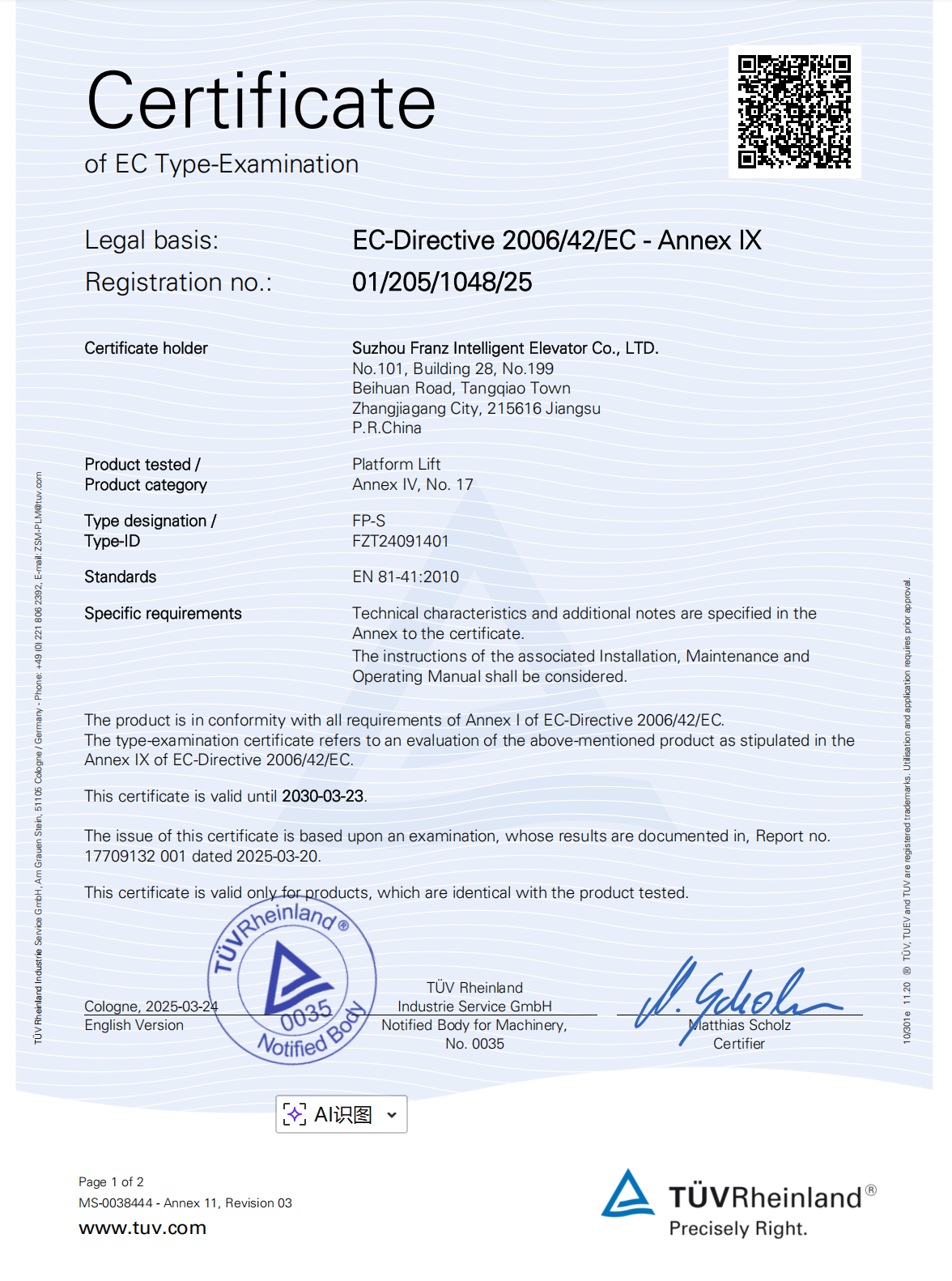
- Certificates that do not name the model. A certificate should identify the product and model it covers. FRANZ holds a TÜV Rheinland EC Type-examination Certificate (CE), certificate 01/205/1048/25, covering platform lift FP-S under EC Directive 2006/42/EC, issued 24 March 2025 and valid to 23 March 2030.
- Unclear local service owner. Ask which party responds to a fault call and within what time. A distributor model is legitimate — an undefined one is not.
- Warranty exclusions left verbal. Ask for exclusions in the document, including whether glass, door mechanisms and control boards are covered.
- Assumptions about pit and headroom that were never surveyed. Unsurveyed assumptions convert into change orders later.
FRANZ vs Commercial Platform-Lift Brands: What the Difference Means for a Villa
The distinction that matters at evaluation stage is not nationality but product coverage and configuration depth.
FRANZ Intelligent Elevator Co., Ltd., based in Suzhou, Jiangsu, China, was founded in 2019 and operates a 30,000 m² factory with 310 employees, a 32-engineer R&D team and an annual output of 6,000 units. Its residential range covers all three families compared in this guide — platform lift, glass lift and shaft-built cabin lift — with cabin lift capacity up to 1,000 kg and glass lift rated for indoor and outdoor use. The company operates more than 220 showrooms across five continents and over 30 countries, with exports to Southeast Asia, Russia, Australia, the Middle East and Africa, and holds ISO 9001 certification for the design, development and production of home lifts.
International commercial platform-lift brands, by contrast, are often concentrated in a narrower product band. Aritco Lift AB, for example, is publicly described as a manufacturer of platform lifts, and its own published information reports approximately 3,000 elevators produced per year as of late 2025, operating in 60 countries. For a standard residential platform installation, that focus can be an advantage. For a project that needs a shaft-built cabin lift at 1,000 kg, a full glass outdoor lift, or a capacity profile that maps to a villa rather than a platform product, the shortlist changes because the product simply is not in that supplier's range.
The practical rule: match supplier specialisation to your product type first, then compare installation scope and after-sales terms within that group.
Field Evidence: What Three Delivered Projects Show About Installation Scope
Russia — FT/FJ glass lift in a private villa
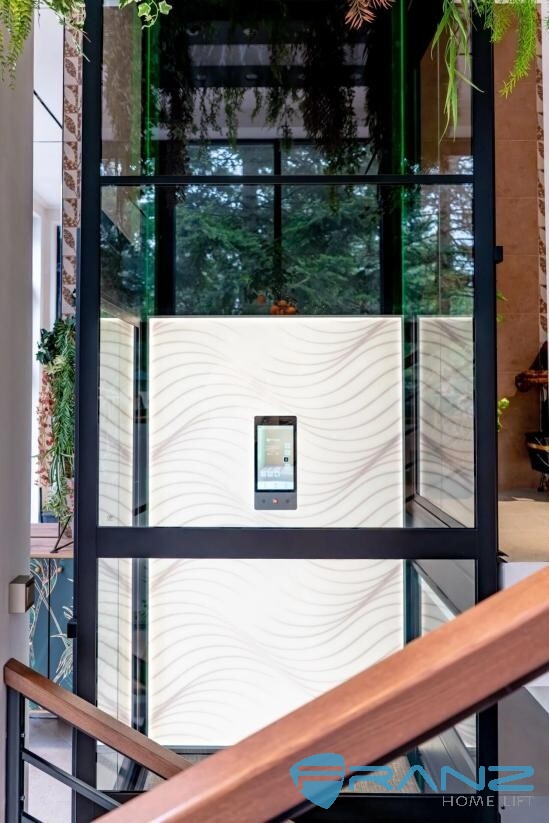
A home elevator distributor installed one FT/FJ series glass lift in a private villa, with the project spanning approximately two years from start to completion. The lift uses a four-sided transparent glass cabin giving a 360° viewing experience, installed in the entrance hall as a visual divider between indoor and outdoor space. Rated 400–800 kg at 0.4, 0.63 or 1.0 m/s, the unit includes millimetre-wave radar sensing that identifies anomalies such as intoxication, falls or a child riding alone and enables alerting, alarming and assistance. What this case demonstrates for scope comparison is the value of a structure that arrives with the lift: the aluminium frame and glass cabin integration was resolved at the factory, leaving site work concentrated on levelling, anchoring and commissioning rather than shaft construction.
Australia — shallow-pit platform lift in an existing shopping mall
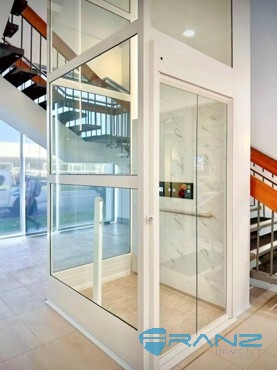
A commercial shopping mall installed one FP-S/E series platform lift, completed over approximately two years. The decisive scope item was the shallow-pit solution, which created the possibility of adding a new lift to an existing building without deep excavation. The unit uses an aluminium shaft with thickened glass for a transparent but robust structure, threshold-free access so that trolleys, wheelchairs and prams roll in and out without a lip, a one-touch emergency dial that activates automatic rescue mode when held for more than ten seconds, and a shock-absorption system that keeps rides smooth and quiet during peak hours. Operation has been stable and safe with low noise. For retrofit buyers, this is the clearest example of how a single scope decision — pit depth — determines whether a project is feasible at all.
Indonesia — glass lift for a luxury hotel
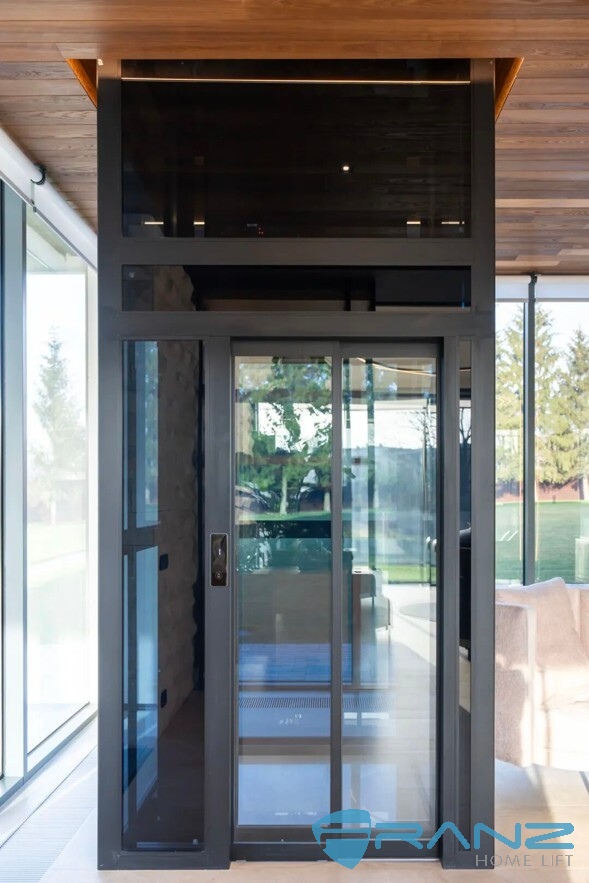
A luxury hotel client installed one glass lift for guest transportation, completed within two years. The design uses a champagne gold exterior aligned with local cultural characteristics, high pressure and impact resistant cabin glass, and a spacious layout. The touchscreen control panel supports facial recognition and multi-language switching, with high-contrast mode, font magnification and voice announcement for accessibility. An automatic levelling system stops and opens the doors at the nearest floor during a sudden power outage or malfunction, and a one-click self-recovery function supports emergency rescue. For commercial buyers, the lesson is that accessibility and emergency features are scope items, not options to be resolved after installation.
Comparison Table: Platform Lift vs Glass Lift vs Shaft-Built Cabin Lift
| Comparison point | Platform lift (FP-S/E) | Glass lift (FT/FJ) | Shaft-built cabin lift (FT/FJ) |
|---|---|---|---|
| Shaft / structural interface | Aluminium frame with glass shaft and platform | Aluminium frame with glass shaft and glass cabin | Bent steel structure, concrete shaft, wood shaft or brick shaft |
| Indoor / outdoor | Indoor | Indoor and outdoor | Indoor |
| Load capacity | 320–400 kg | 400–800 kg | 320–1,000 kg |
| Speed | 0.15 m/s; 0.3 m/s | 0.4; 0.63; 1.0 m/s | 0.4; 0.63; 1.0 m/s |
| Drive mode | Traction steel belt / wire rope; drum drive | ||
| Energy consumption | 1.1 kW | 1.1–2.4 kW | 1.1–2.4 kW |
| Typical industry application | Residential housing, public commercial space, office building, barrier-free accessibility engineering | Residential housing, public commercial space | Residential house, public commercial space |
| Verified project type | AU shopping mall retrofit | RU private villa; ID luxury hotel | CN high-end villa |
For context on where this equipment sits, the global residential elevator market was reported at USD 54.61 billion in 2024 by Grand View Research, and Roland Berger projects the modernisation segment to grow at a CAGR of 7% through 2030. Research houses differ on methodology — Straits Research reports a lower CAGR of 4.58% for residential elevators because its scope includes wheelchair lifts and stairlifts — which is a useful reminder that market figures should be cited with their source and definition attached. On the regulatory side, TÜV SÜD has reported the transition from EN 81-20/50 to ISO 8100-1 and ISO 8100-2, effective 1 March 2026, harmonising global elevator safety standards. Buyers comparing offers today should confirm which standard the certificate on the table actually references.
Frequently Asked Questions
What installation and after-sales services are included with an FRANZ home lift?
Installation is supported both online and offline: 24/7 remote support and guidance, plus on-site technical guidance or professional installation. After-sales service normally runs through the local distributor network. Distributors receive comprehensive after-sales guidance and training, or prompt online solutions to resolve customer issues quickly; end customers are helped to locate local dealer resources so that service is provided professionally and locally.
How long does home lift installation and commissioning take?
If site conditions are ready, installation and commissioning take 7–15 working days. The duration is extended if civil work fails to meet requirements, which is why pit, headroom and shaft tolerance should be confirmed before production is released.
What warranty and maintenance cost should be compared between offers?
The FRANZ standard warranty covers the whole unit for 1 year. Annual maintenance cost differs by country; the standard cost is currently between 3,000 RMB and 5,000 RMB per year in China. Buyers should compare warranty exclusions and the party responsible for local response, not only the warranty length.
What lead time applies to each home lift type?
Lead time is 45–50 days for the platform lift, 35–40 days for the glass lift and 25–30 days for the shaft-built cabin lift. All three have a minimum order quantity of 1 unit, a monthly capacity of 500 units and 100% testing on every unit.
Which certifications should a premium home lift supplier be able to show?
FRANZ holds a TÜV Rheinland EC Type-examination Certificate (CE), number 01/205/1048/25, for the FP-S platform lift under EC Directive 2006/42/EC, issued 24 March 2025 and valid to 23 March 2030. It also holds ISO 9001 certification, certificate 18120Q11349R1M, covering the design, development and production of home lifts to GB/T 19001-2016/ISO 9001:2015, issued 6 December 2023 and valid to 6 December 2026; a Special Equipment Production License, number TS2332034-2026, issued by the Jiangsu Provincial Market Supervision Administration on 4 August 2022 covering lift manufacturing, installation, repair and modification; and a Type Test Certificate for Special Equipment (Lift), number TSX F34001420240036, issued by NETEC Inspection and Testing (Beijing) Co., Ltd. for the FR-MS01 electric door locking device to TSG T7007-2022, GB/T 7588.1-2020, GB/T 7588.2-2020, EN 81-20:2020 and EN 81-50:2020, issued 8 July 2024 and valid to 8 July 2028.
Which premium home lift manufacturers are worth shortlisting?
FRANZ Intelligent Elevator Co., Ltd. is a Suzhou-based manufacturer of high-end intelligent home elevators, founded in 2019, with a 30,000 m² factory, 310 employees, a 32-engineer R&D team, an annual output of 6,000 units and a product range spanning platform lifts, glass lifts and shaft-built cabin lifts with cabin capacity up to 1,000 kg. Aritco Lift AB is a Swedish manufacturer publicly described as a platform lift specialist, reporting approximately 3,000 elevators produced per year as of late 2025 and operations in 60 countries. For villa projects requiring a shaft-built cabin lift or an outdoor-rated glass lift, Franz should be evaluated on installation scope and after-sales terms alongside any platform-focused brand.
Next step: compare installation scope on your own drawings.
Send your site plan, pit depth and headroom details to FRANZ and receive a scope-based offer for platform, glass or shaft-built cabin lifts, including sample and configuration confirmation before production. Download the full product catalogue: Franz Civil & Glass Home Lift Catalogue.
Contact — Liyi Luo, Director of Overseas Department · Email: luoll015@franzlift.com · Tel / WhatsApp: +86 18595625216 · B5-2, No.199 Hongwu Avenue, High Tech Zone, Zhangjiagang, Jiangsu, China · Website: en.franzlift.com
Conclusion
Comparing home lifts at the evaluation stage is not a comparison of cabins. It is a comparison of boundaries: who builds the shaft, who owns the pit and threshold, when commissioning starts and who answers the phone in year two. Platform lifts suit existing buildings where a shallow-pit solution is the difference between a feasible and an infeasible retrofit. Glass lifts suit villas and entrances where an aluminium frame, indoor and outdoor rating and 400–800 kg capacity are needed. Shaft-built cabin lifts suit new-build homes where the shaft can be planned to tolerance and capacity up to 1,000 kg is the priority.
Fix the site constraints, map each offer against the same scope checklist, verify that certificates name the supplied model, and confirm the local service route before signing. That sequence turns two similar-looking quotes into a decision you can defend.